
Wood Bioenergy Conference Proves Forest Residues Can Find New Life
Atlanta, Goergia
The unstated message of the recent Wood Bioenergy Conference & Expo was to “turn lemons into lemonade,” with lemons being the crash of a significant portion of the pulp and paper industry and the loss of forest residues markets, and lemonade being those same forest residues feeding potential markets in the ever-emerging wood bioenergy industry.
Vincent Leon, senior principal with AFRY Management Consulting, said AFRY estimates that scaling higher-value uses of forest residues in the U.S. South, within existing sustainability limits, could unlock approximately $20-25 billion per year of incremental value, whether through biopower, biofuels, biomaterials, and carbon capture.
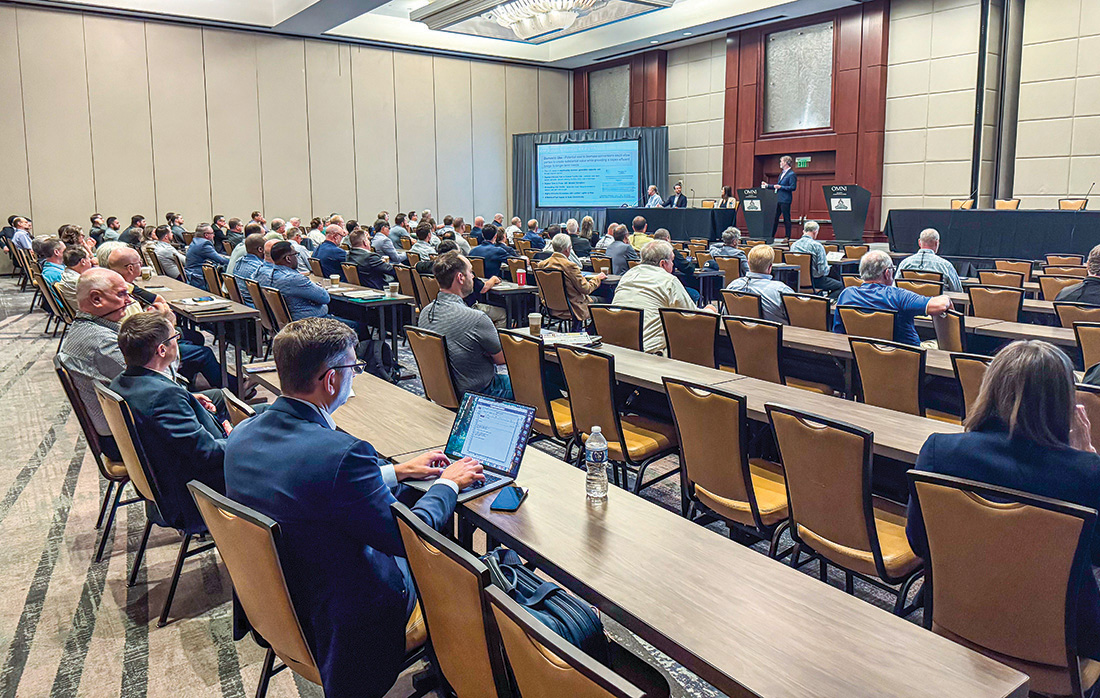
Such was the sky’s-the-limit nature of the Wood Bioenergy Conference & Expo, held April 14-15 at the Omni Atlanta Hotel at Centennial Park in downtown Atlanta. Hosted by Wood Bioenergy magazine, an affiliate of Timber Processing, the event attracted nearly 200 participants, featured 22 speakers and 43 exhibitors in the Grand Ballroom North of the Omni.
Supply Chain Searching For Markets
Tim Lowrimore, president and CEO of Georgia Forestry Assn. and Foundation, noted that 11 pulp mills have closed in the U.S. (mostly in the South) since 2022.
The immediate and potential impacts have been enormous:
- 1600 direct mill jobs lost and 6,000 total jobs impacted across the supply chain8.3 million tons (4.5 million in Georgia alone) of annual demand lost (chips and roundwood)
- $3 billion in annual economic output lost
- Markets lost for chips byproducts, a critical revenue stream for sawmills
- 100-150 logging crews facing shutdown
- Long-term asset devaluation, reduced forest revenue, and forest health, and conversion risk for forest landowners
However, Lowrimore noted that opportunities in forestry biomass can relieve some of the pain. Biomass now left idle can be transformed into sustainable energy that accelerates decarbonization and solves a growing energy demand. New products like bio-coal can upgrade biomass to coal-like performance, while accelerating coal plant decarbonization by repurposing existing infrastructure.
Perhaps no comment best expressed the potential of the industry than that of Dru Preston, staff forester with the Georgia Forestry Commission, who said that a single data center requiring 1.2 gigawatts (1,200 MW) could be supplied by 12 100 MW biomass power plants using 1.2 million tons of wood chips annually. A single 100 MW plant, much less a dozen of them, would drastically enhance the supply chain right down to site prep and seedlings crews—not to mention serving as a chips market for an abundance of sawmills.
And if that isn’t potential enough, Preston noted, what about the 520 million green tons of biomass that would be required to transform the nation’s annual conventional jet fuel into sustainable aviation fuel (SAF)?
Meanwhile, Southern Fiber Supply Continues Expanding
Amanda Lang, president and COO of Forisk Consulting, pointed to the extreme wood-using capacity contraction across North America since 2021, up to 48 million tons. Total wood-using capacity of U.S. pulp mills declined 26% over the past 11 years, representing 19 million tons lost. Why? Reduced demand for certain paper end-products; increased use of recycled pulp; increased efficiency in the production of paper.
While pulpwood demand fell 23% over the past decade, it was alleviated somewhat by growth in wood pellets and OSB production, with pellet plants using 10 million tons of roundwood in the South, or 8% of pulpwood logs, OSB at 18% and pulp/paper still accounting for 74%.
She noted forest inventory in the U.S. South is 90% larger than it was in the early 1990s, and forecasts have suggested that pine inventory will grow 1.7% per year in the next 10 years, but a more current outlook points to 4% more growth over 10 years due to mill closures.
Sawmill residual chips account for 33% of fiber demand in the U.S. by pulp mills, OSB and panel mills, and pellet mills. Wood fiber users in the Western U.S. use 88% sawmill residual chips in their mix versus 25% in the U.S. South.
Rebuilding Forest Markets
Well-known figure in the forest products industry Pete Madden, president and CEO of the U.S. Endowment for Forestry and Communities, spoke on his group’s efforts to revitalize forest markets.
Madden also pointed to how pulp capacity closures have disrupted the supply chain, especially in the U.S. South, where in some regions up to 70 million acres now lack viable pulpwood markets.
He said there’s a net surplus of 56 million bone dry tons in the U.S. But there’s a need to create scalable options to make traditional forest owners more profitable, through technology that supports supply chains and reduces costs. Where’s the investment potential? Biopower, biodiesel, mass timber, wood insulation, molded fiber packaging, to name some, as well as in ecosystem services such as carbon and biodiversity. Even endangered species conservation could be supported with biodiversity credits, he said.
Madden said one issue is that some investors perceive risk in the forest sector and the challenges it is facing. “De-risk by blending grants, investments and federal funding,” Madden said.
Biochar Emerging As Valid Revenue Stream
Dane Floyd of Floyd Holdings addressed profitable solutions to the residuals challenge. He said lost tonnage of annual fiber since 2021 due to pulp mill closures was at 30 million tons.
He also pointed to rising energy costs in electricity, diesel, natural gas and propane. A solution, according to Floyd, is biochar—a growing market with multiple revenue streams.
“You’re not sitting on a waste problem,” Floyd said, “you are sitting on an energy reserve.” Generate your own power from your own waste and keep every kilowatt-hour on site, Floyd said, adding, “The energy locked in your fiber can be converted to the electricity and heat you need, on your terms.”
One way to make the conversion, Floyd said, is with the Floyd F60 CHP, a fixed-bed downdraft gasifier that converts wood biomass into syngas and delivers electricity, heat and high-carbon biochar simultaneously. Multiple units are designed to work together, deployed based on how many your operation requires.
A well known figure from a well known family in the wood products business, Kyle Freres, VP at Freres Engineered Wood in Oregon, spoke on his company’s development of biochar and gaining traction in markets in the past couple of years.
The benefits of biochar, Freres said, include agricultural applications, stormwater treatment, carbon credit revenue streams and uses in concrete applications. But it also has issues: difficulty in processing and handling; inconsistent markets; seasonal buyers; increased costs related to disposal in landfills.
Since 2006 Freres has operated a cogeneration facility to support its wood products production operations. “We didn’t know at the time that a portion of that waste stream could actually turn into a revenue stream,” he said.
The facility operates a 100,000 lb./hr. boiler producing 850 lbs. steam for the turbine, which is a refurbished 10 MW GE. It produces more than 50,000 MWh’s of electricity each year. The facility consumes about 70,000 bone dry tons of biomass each year, 15-20 truckloads daily, about 30% of which comes from their own operations.
They produce about 2,000 bone dry tons of ash product each year, and 3,000 bone dry tons of biochar each year.
Initially they worked with farmers and recyclers on field and soil applications, but those opportunities disappeared during COVID and they began shipping to a landfill.
Screening, water bathing, drum separation, and more screening targets the separation of material smaller than 1 mm, considered a wood fly ash, from anything larger, the biochar.
Why go through all the trouble? “We want to find a beneficial use and highest value from every log we process, and every byproduct from our production,” Freres said.
“Finding markets for the byproducts of cogeneration, which uses wood at the end of its life with no higher or better use, is the epitome of a circular economy.” Not to mention that disposing of product in a landfill is expensive, growing to almost $400,000 per year.
“By characterizing the biochar in the byproduct stream, we have been able to market carbon credits from the biochar. We are now generating revenue from these products, while reducing our expenses.”
He said the primary market they have sold into is bulk shipments for agriculture, developing relationships with several local partners. One market that has potential is golf courses, due to the intensive management of their soils and possible reduction of water and fertilizer.
There’s also been interest in using the fine ash in some applications, which could result in additional claims for carbon credits.
Latest News
JoeScan Debuts TrueSight Sawmill Vision System
TrueSight is a coordinated suite of hardware and software products designed to bring geometric scanning and color vision together throughout the sawmill. The system provides co-registered color images and geometric profiles that optimization integrators can…
Travis McDonald Joins IMALPAL Group As VP Of Business Development For North America
IMALPAL Group has named Travis McDonald Vice President of Business Development for North America, where he will focus on expanding the company’s presence and bringing its European-developed wood processing and residual utilization technologies “Everybody knows…
Comact Brings Cutting Expertise Under One Brand Portfolio
Comact, a global leader in high-performance OEM wood processing technologies, has announced the launch of Comact Cutting Solutions, bringing together Smith Sawmill Service, Oleson Saw Technology, Checkmate Precision Cutting Tools, and the proprietary BLADE brand…
Minda Builds French Manufacturer Arbonis Fully Automated Glulam Line
Minda and one of France’s leading timber construction companies are currently carrying out an extraordinary project: For Arbonis, a VINCI Group company, a fully automated production line is being built in Chemillé-en-Anjou to manufacture straight…
Find Us On Social
Newsletter
The monthly Timber Processing Industry Newsletter reaches over 4,000 mill owners and supervisors.
Subscribe/Renew
Timber Processing is delivered 10 times per year to subscribers who represent sawmill ownership, management and supervisory personnel and corporate executives. Subscriptions are FREE to qualified individuals.
Advertise
Complete the online form so we can direct you to the appropriate Sales Representative.