
Isaias Damages $33.5 Million in Alabama Timber
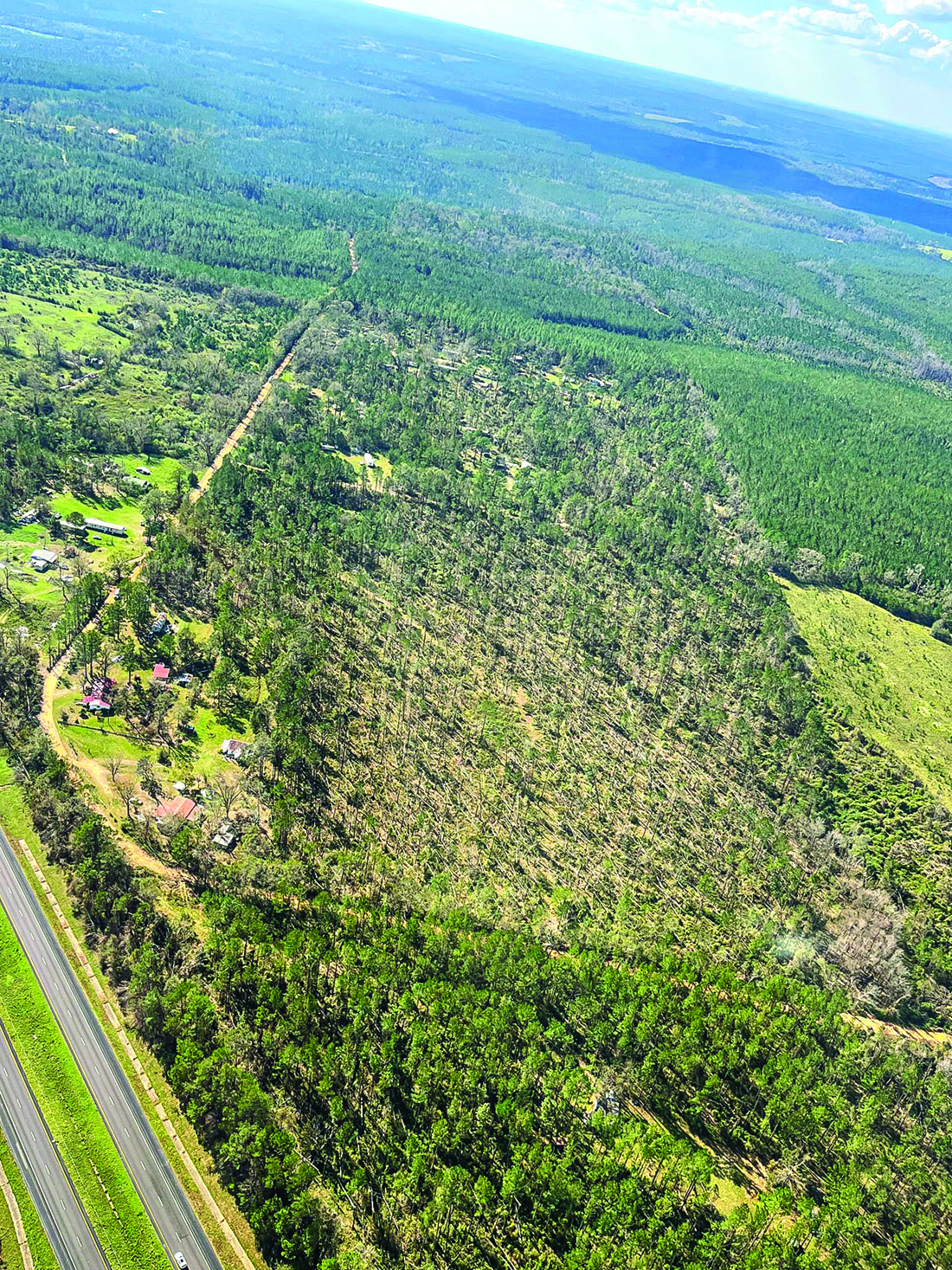 Hurricane Isaias damaged more than 2.5 million tons of timber valued at more than $33.5 million in southwest Alabama, according to a preliminary aerial assessment by the Alabama Forestry Commission (AFC).
The Category 2 storm made landfall near Destin, Fla. on October 9 with maximum sustained winds of 105 MPH.
AFC pilots surveyed the affected region on October 13 and mapped a path of approximately 36 miles long and up to seven miles wide. Within the 154,783-acre impacted area, roughly 105,000 acres were forested, including 64,795 acres of forestland and 40,805 acres of woody wetlands.
“While we are thankful the damage was not as extensive as it could have been, these losses are still devastating for Alabama landowners,” Alabama State Forester Rick Oates said in a press release. “Growing timber is a long-term investment, requiring decades of hard work, careful management and financial commitment.”
Dan Chappell, coordinator of the AFC’s Forest Inventory and Analysis (FIA) program, says the heaviest damage was concentrated in a narrow band through the heart of Escambia County, across Interstate 65 in Conecuh County and into parts of Monroe County. The AFC has not received reports of widespread forest damage in other counties.
The AFC used a new damage-rating system shared across the U.S. South and designed to analyze regional disasters consistently across state lines. Aerial spotters sorted damage into one of three categories: light (0–15%), moderate (16–50%) or severe (51–100%). The AFC then quantified timber damage by converting those ratings into tonnage and dollar estimates using FIA plot data.
“It’s less precise but more accurate overall,” Chappell said. “Spotters work from about 2,000 feet of elevation at 130 miles per hour, and the broader categories keep them from having to pinpoint an exact percentage. Most of the damaged observation points fell within the moderate category, and a little over a quarter were rated severe. Overall, damage averaged near 40%.”
No federal disaster funding for timber losses has been announced to date, and the USDA Forest Service has not yet said whether it will activate a damage protocol. Chappell says the AFC can conduct a post-disaster FIA ground survey if requested by federal officials.
“We all know the industry is not in a great time across its product classes,” Chappell said. “Demand for finished products is flat, so a surge of salvage wood is likely to drive stumpage values down. Salvage is tough.”
The AFC recommends that affected landowners consult a registered forester for an on-the-ground assessment before making salvage decisions. The commission’s website has tools for finding forestry professionals by service and county, and the AFC encourages landowners to utilize USDA Forest Service resources on storm recovery and timber casualty-loss tax tips.
Latest News
JoeScan Debuts TrueSight Sawmill Vision System
TrueSight is a coordinated suite of hardware and software products designed to bring geometric scanning and color vision together throughout the sawmill. The system provides co-registered color images and geometric profiles that optimization integrators can…
Travis McDonald Joins IMALPAL Group As VP Of Business Development For North America
IMALPAL Group has named Travis McDonald Vice President of Business Development for North America, where he will focus on expanding the company’s presence and bringing its European-developed wood processing and residual utilization technologies “Everybody knows…
Comact Brings Cutting Expertise Under One Brand Portfolio
Comact, a global leader in high-performance OEM wood processing technologies, has announced the launch of Comact Cutting Solutions, bringing together Smith Sawmill Service, Oleson Saw Technology, Checkmate Precision Cutting Tools, and the proprietary BLADE brand…
Minda Builds French Manufacturer Arbonis Fully Automated Glulam Line
Minda and one of France’s leading timber construction companies are currently carrying out an extraordinary project: For Arbonis, a VINCI Group company, a fully automated production line is being built in Chemillé-en-Anjou to manufacture straight…
Find Us On Social
Newsletter
The monthly Timber Processing Industry Newsletter reaches over 4,000 mill owners and supervisors.
Subscribe/Renew
Timber Processing is delivered 10 times per year to subscribers who represent sawmill ownership, management and supervisory personnel and corporate executives. Subscriptions are FREE to qualified individuals.
Advertise
Complete the online form so we can direct you to the appropriate Sales Representative.