
Dempsey Wood Products Upgrades Planer Mill With USNR
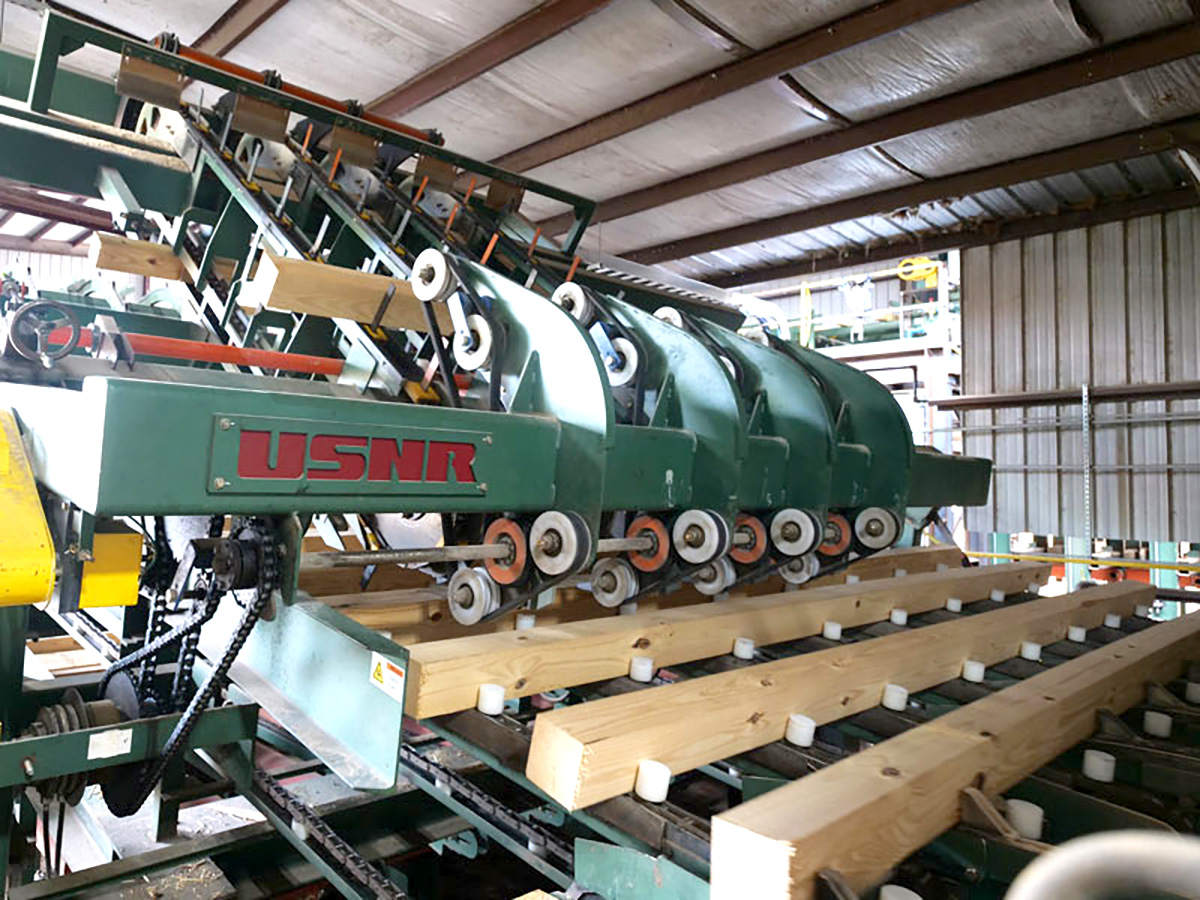 After upgrading the sawmill a few years ago, South Carolina’s Dempsey Wood Products found that it outran the planer mill, with the added challenge that the planer mill had no room for expansion in any direction. The best solution would require an unconventional layout that had never been done before, including two 90° transfers making a 180° u-turn, to fit the line into the existing space.
“In retrofit situations no mill ever has enough real estate, so to figure out how to work with what you have and make it function well, that’s a testimony in my book,” Dempsey Wood Products President Parker Dempsey says.
The heart of the project is the transverse high grader (THG) automated grading system along with a 20 bin sorter that has allowed Dempsey to expand its range of products, boost production, and increase grade, all without increasing planer speed or labor.
Timbers from the sawmill are dried with USNR’s Counter Flow kiln and forklifted onto a used USNR tilt hoist that Dempsey bought from a nearby mill after that mill purchased a new one. Pieces are then unstacked and planed.
Planed timbers exit the planer and land on an extended slow-down belt that takes them over the grading line and drops them into the flow.
USNR designed a specialized drop transfer made specifically for this application that achieves a fast and effective 90° directional change. Pieces are then fed into lugs by a Revolver lug loader and sent to the THG for automated grading.
A Multi-Track Fence even-ends them and a Clamshell trimmer processes the trim solutions as defined by the THG.
When there is a cut-n-two solution, half of the piece remains in the same lug space, and the other half is diverted up a recirculation elevator, allowing time for the system to create an empty lug space. The halfpiece comes back down and fills the empty lug space that was created for it, and continues in the flow.
In Dempsey’s planer mill, trimmed timbers travel up an incline and make a 180° turn toward the 20 bin pusher lug sorter which is positioned parallel to the grading line.
Michael Gulley, Dempsey GM of Operations, comments, “That’s one reason the sorter with the recirculation tower was such a huge hit. Graders were having to hand pull, and for every piece that is hand pulled, with cut-n-two, it becomes two pieces.”
This configuration provides an opportunity to make two short-length boards from one low-value longlength board, without sacrificing line speeds or throughput volumes.
USNR’s cut-n-two design allows both halves of the board to remain in the same lug space, so the line is able to run at a consistent speed while cutting longer products.
As a result, Dempsey Wood Products was able to expand from a 12-foot mill to producing 16-foot lumber.
Parker said, “Going from 12-foot to 16-foot opens up many more options; crook grading, all the grades, trimming, handling, and cut-n-twos.”
The improvements implemented at Dempsey removed significant bottlenecks, allowing it to expand its range of products, and to remain on a single shift.
The 16-foot capability gives them the option to broaden that. And being able to cut a 16-foot board in two, at a high volume to produce two 8-foot boards, is a game changer for the mill.
Dempsey Wood Products has enjoyed a production increase of four feet per piece because of the longer lengths due solely to the THG automated grader reconfiguration.
Ironically, Dempsey’s grade actually went down on the 5/4 in. x 6 in. boards, because the THG sees everything including details that a manual grader normally wouldn’t see, including the smallest bit of skip dressing. The 5/4 decking product has strict limits on skip dressing.
Latest News
Conifex Announces McLellan As President, COO
Conifex Timber Inc. has announced that Andrew McLellan has been promoted to President and Chief Operating Officer. As President, McLellan will lead Conifex’s business units and pursue value-added opportunities in fiber procurement, lumber manufacturing and marketing, green power generation, and other complementary businesses. Andrew retains responsibility for forest…
Binderholz Celebrates Enfield Sawmill Opening
Binderholz Enfield LLC held a grand-opening in April to commemorate the official opening of its lumber production facility near Enfield in Halifax County, NC. Company, local community, and elected officials participated in the event alongside Binderholz’s corporate leadership from Austria. The Enfield facility will produce southern yellow pine lumber used in residential and…
Mercer Launches ‘Growing Forests – Growing A Future’ Program
Mercer had announced the launch of a program supporting forest owners in Germany, called “Growing Forests – Growing A Future.” Mercer Holz, the wood purchasing arm of Mercer, is committed to partnering with forest owners in Germany to sustain the longevity of their forests…
Arxada Teams With ICONX
Arxada and ICONX Chemicals, in partnership with service provider Zee Water & Energy, announced a new distribution partnership for AntiBlu and Mycostat products in the Eastern half of the U.S. Arxada’s antisapstain chemicals, including anti-mold and anti-fungals, brighteners, and defoamers, bring cleaner and brighter wood to the marketplace and protect the value of…
Find Us On Social
Newsletter
The monthly Timber Processing Industry Newsletter reaches over 4,000 mill owners and supervisors.
Subscribe/Renew
Timber Processing is delivered 10 times per year to subscribers who represent sawmill ownership, management and supervisory personnel and corporate executives. Subscriptions are FREE to qualified individuals.
Advertise
Complete the online form so we can direct you to the appropriate Sales Representative.