
May 2026
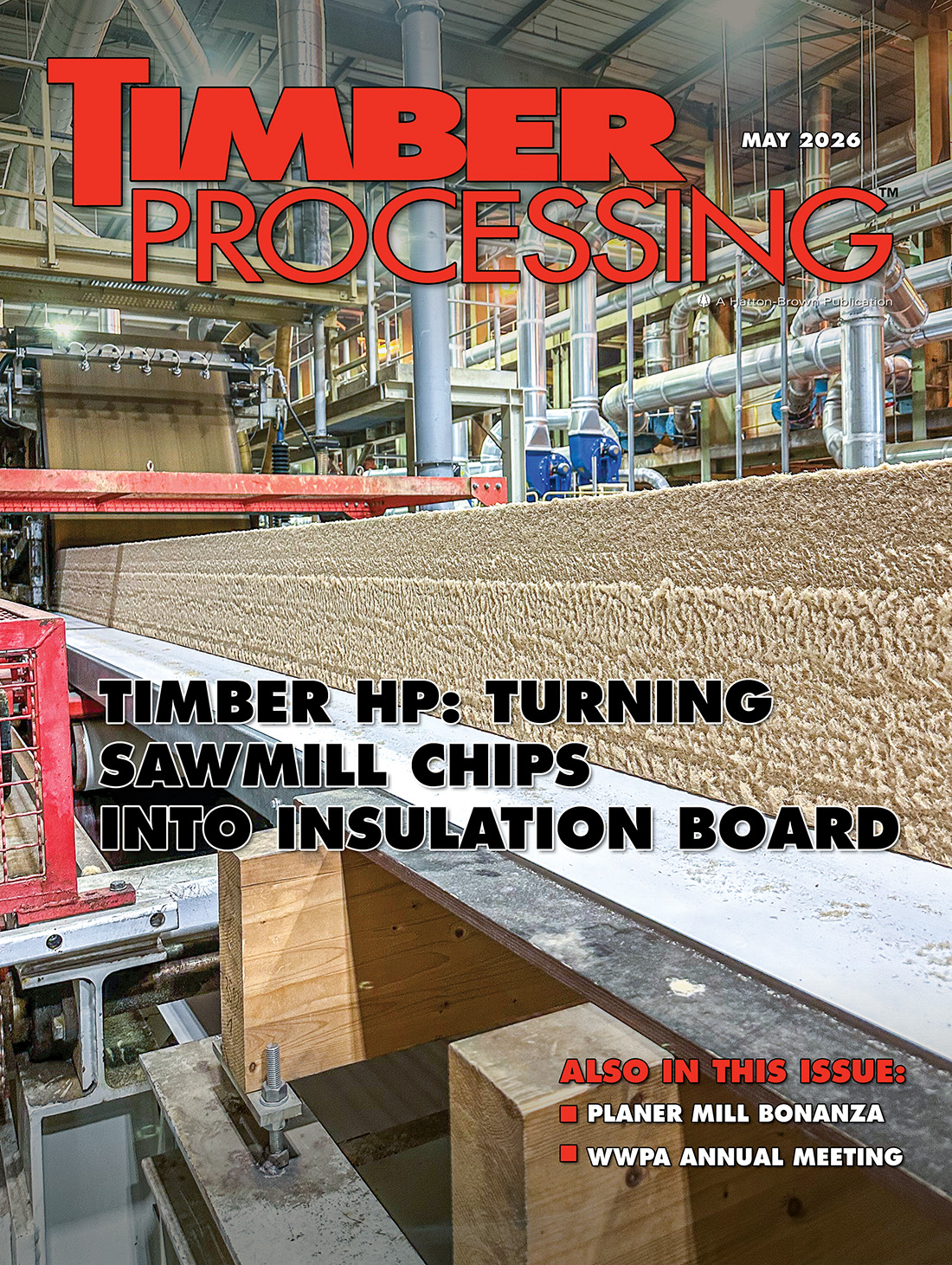
Cover: TimberHP springs to life in Madison, Maine with its wood insulation products built with sawmill by products.
Inside This Issue
THE ISSUES: One Solution To The Byproducts Problem
For most sawmills across North America chips and dust are becoming a Bottleneck.
NEWSfeed
- USFS Begins Major Overhaul
- USDA Streamlines NEPA Regulations
- Gresham Acquires Majority Of Molpus
- Rayonier Sticks With Rayonier
- Duties Are Lowered, But Still Prevalent
COVER: Timber HP: Turning Sawmill Chips Into Insulation Board
TimberHP takes a shuttered paper mill and creates the first wood fiber insulation board production facility in the U.S.
MACHINERY ROW
- McDonough, A&E Introduce Resaw System
- Carbotech Teams With Innovation Nórdica
- SII Dry Kilns Names Sales Representative
- Sweed Appoints Hensley As Sales Manager
- Grenzebach Names VP Global Sales
AT Large
- WWPA Continues Annual Tradition
- New Roseburg Mill Hits Its Stride
- Canfor Releases Sustainability Report
- Davis Timber Steps Up Again In DeRidder
Find Us On Social
The Issues: One Solution To The Byproducts Problem
Article by Jessica Johnson, Senior Editor, Timber Processing
For most sawmills across North America chips and dust are becoming a bottleneck. According to recent data from Forisk Consulting, total capacity of U.S. wood-using pulp mills declined 26% over the past 11 years, which accounts for 19 million lost tons consumed. Another scary fact: The percentage of residue chips has increased in the South from 20% in 2019 to 25% in 2026. Sawmill residual chips account for 33% of fiber demand in the U.S. by pulp, panel, OSB, and pellet mills. Wood fiber users in the Western U.S. use 88% sawmill residual chips in their mix versus 25% in the U.S. South.
What if an architect and a chemist in Maine came up with another market for sawmill chips? When architect Matthew O’Malia began his wood fiber insulation startup, TimberHP, he wanted to create something that helped him build better homes. What he also did was create a market in Maine that was desperately needed for the region’s sawmills hit hard by paper mill closures.
The operation, built inside a closed paper mill, runs almost entirely on sawmill chips to feed two fiber lines making three wood fiber insulation products. And while TimberHP is still technically considered a startup, and requires constant hustling to find investors and make sales into the building market, the mill is at an industrial scale. In an area of the country where there are no industrial wood pellet manufacturers, paper mills are scarce and the biomass power generation market by and large no longer exists, TimberHP and its wood fiber insulation could be the answer to the byproduct bottleneck in Maine—if not the whole answer, at least part of it.
What is perhaps most interesting is the idea that TimberHP could be replicated fairly easily in other parts of the country at scale. Forisk estimates that the South will represent 46% of U.S. lumber consumption in 2026. A wood fiber insulation plant that has been proven on Eastern white pine could easily translate to Southern yellow pine…maybe. Especially when you consider that unlike its panel cousins, TimberHP’s product lines aren’t strictly commodity boards. Instead, the insulation is designed to replace fiberglass, mineral wool and foam in the building envelope.
From a chip producer’s point of view, this new market isn’t tied to unfamiliar external forces. If housing starts are up, lumber, and in theory wood fiber insulation, demand is up. No more hunting and hoping for someone to save a pulp mill, or governmental regulations to incentivize biomass power production abroad. Instead, TimberHP is a dedicated, consistent, high-value user of chips that is tied to long-term trends in insulation and building performance.
There’s a catch, however: Insulation products, particularly low-density loose- fill and batts, are high freight items, just like sawmill chips. None of these products move efficiently across the continent, so the likelihood of a behemoth wood fiber insulation plant isn’t great.
But, it does create a template for replication and possibility for creating a network of medium-scale plants in timber rich areas adjacent strong construction markets. To me, that sounds a heck of a lot like most of the U.S. South, and definitely parts of the Pacific Northwest.
No one plant (or concept) is going to solve the sawmill byproducts market issue. But what’s happening in Madison, Me. is practical, instructive, and darn sure something to pay attention to.
Want More Content?
Timber Processing magazine is delivered 11 times per year to subscribers, who represent sawmill ownership, management and supervisory personnel and corporate executives.
Newsletter
The monthly Timber Processing Industry Newsletter reaches over 4,000 mill owners and supervisors.
Subscribe/Renew
Timber Processing is delivered 10 times per year to subscribers who represent sawmill ownership, management and supervisory personnel and corporate executives. Subscriptions are FREE to qualified individuals.
Advertise
Complete the online form so we can direct you to the appropriate Sales Representative.